Nearly half of all veneers placed worldwide now use ultra-thin, no prep techniques — and it is easy to understand why. Patients discovered that a complete smile transformation no longer requires grinding down healthy enamel, sitting through hours of uncomfortable drilling, or committing to an irreversible procedure. No prep veneers deliver the same aesthetic result through a fundamentally more respectful approach to your teeth.
This guide gives you everything you need to make a fully informed decision: what no prep veneers actually are, what the clinical evidence says about how long they last, who genuinely qualifies (and who does not), how Turkey pricing compares to Western costs, and a day-by-day itinerary for completing treatment in five days.
What you will learn:
- How no prep veneers differ from traditional and composite options
- The honest candidacy checklist — including who should not get them
- Clinical survival rate data from peer-reviewed studies
- Real Turkey pricing and what an all-inclusive package covers
- The Ministry of Health safety framework protecting international patients
- Five common mistakes that shorten veneer lifespan
Table of Contents
- What Are No Prep Veneers?
- No Prep vs. Traditional vs. Composite: Side-by-Side Comparison
- Are You a Good Candidate? The Honest Checklist
- The Clinical Evidence: What 9 Years of Studies Say
- The 3 Main No Prep Veneer Brands Explained
- No Prep Veneers in Turkey: Prices, Packages, and What’s Included
- Your 5-Day No Prep Veneers Turkey Itinerary
- Is It Safe? Turkey’s 2025 Ministry of Health Framework
- 5 Mistakes That Shorten Your No Prep Veneers Lifespan
- Aftercare: How to Make Them Last 15+ Years
- FAQ
What Are No Prep Veneers?
No prep veneers are ultra-thin ceramic shells — typically 0.2 to 0.3 millimetres thick — bonded directly onto the front surface of existing teeth without removing any enamel. To put that thickness in perspective: a standard contact lens is approximately 0.1 mm thick. These veneers are roughly twice that measurement, yet strong enough to withstand normal biting forces for a decade or more.
Traditional porcelain veneers require the dentist to remove 0.5–1.5 mm of enamel from each tooth before bonding. That enamel never grows back, which makes traditional veneers a permanent, irreversible commitment. Prepless veneers eliminate that step entirely. The ceramic bonds directly to intact enamel using advanced resin cement, and the tooth beneath remains exactly as it was before treatment.
The clinical significance of that distinction is considerable. Because no enamel is removed, these ultra-thin restorations are fully reversible — if you ever choose to have them taken off, your natural teeth underneath are untouched. They also require little to no local anaesthesia, involve no post-procedure sensitivity from exposed dentine, and can typically be completed in fewer appointments.
The global dental veneers market reached $2.36 billion in 2025 and is projected to grow to $3.95 billion by 2032 at a CAGR of 7.6%, with ultra-thin and prepless techniques now accounting for nearly 37% of all veneer procedures worldwide.
No Prep vs. Traditional vs. Composite: Side-by-Side Comparison
Not every patient needs the same solution. Understanding the genuine differences between prepless veneers, traditional porcelain veneers, and composite veneers helps you choose the treatment that fits your clinical needs — not just your budget.
| Feature | No Prep Veneers | Traditional Porcelain Veneers | Composite Veneers |
|---|---|---|---|
| Enamel removal | None (0 mm) | 0.5–1.5 mm | None or minimal |
| Reversibility | Fully reversible | Permanent | Reversible |
| Thickness | 0.2–0.3 mm | 0.5–1.0 mm | Variable |
| Longevity | 10–15 years | 10–20 years | 5–7 years |
| Anaesthesia | Rarely needed | Usually required | Not needed |
| Appointments | 2 (+ lab period) | 2–3 (+ lab period) | 1 (chairside) |
| Best for | Minor corrections, healthy enamel | Moderate-severe corrections | Fastest result, lowest cost |
| Turkey cost (per tooth) | $450–$970 | $225–$350 | $100–$150 |
| UK cost (per tooth) | £800–£1,500 | £700–£1,200 | £250–£600 |
No prep veneers win when: you have healthy, normally-sized teeth with minor cosmetic issues — small gaps, mild discoloration, slight chips or uneven edges — and you value reversibility.
Traditional veneers win when: the correction required is more significant — deeper discoloration, larger gaps, or more structural reshaping — and you are comfortable with a permanent commitment.
Composite wins when: speed and price are the priority, or you want a temporary preview of your new smile before committing to porcelain. Explore the Hollywood Smile treatment page if a full aesthetic redesign combining multiple techniques is what you have in mind.
Are You a Good Candidate? The Honest Checklist
These ultra-thin restorations are not the right choice for every patient. In fact, clinical studies suggest only 4 in 10 veneer cases are genuinely suitable for a true prepless approach. The aesthetic result depends entirely on the veneer sitting flush against the tooth surface — which requires certain baseline conditions.
You ARE likely a good candidate if you have:
- Mild to moderate tooth discoloration (up to 2 shades above whitening scale)
- Small gaps or spaces between teeth (diastema)
- Minor chips or worn edges on front teeth
- Slightly uneven tooth lengths or shapes
- Healthy gums with no active gum disease
- Sufficient enamel for strong adhesion
- Normal or small tooth size (not prominent or protrusive teeth)
- A stable bite with no heavy grinding habit
You are likely NOT a suitable candidate if you have:
- Bruxism (teeth grinding): The 0.2–0.3 mm thickness makes these ultra-thin shells vulnerable to fracture under heavy grinding forces. Patients with bruxism require either traditional veneers with a custom night guard, or treatment of the grinding habit before proceeding.
- Severe tooth misalignment: Veneers — prep or no prep — cannot correct significant crowding or rotation. Orthodontic treatment should come first.
- Large or prominent teeth: Adding even 0.3 mm to an already-prominent tooth makes it look bulkier and can affect speech. Traditional veneers, which actually reduce the tooth’s profile before building it back up, produce a better result.
- Deep discoloration: Prepless veneers cannot mask discoloration more than 2 tones above the shade scale. Severe tetracycline staining, for example, requires opaque porcelain that needs more depth than no prep thickness allows.
- Active gum disease or poor oral hygiene: Inflamed, receding gums cannot provide the stable foundation these thin restorations require. Any gum condition must be resolved before veneer placement.
- Severely compromised enamel: These restorations bond to enamel, not to dentine. Patients with extensive enamel erosion may not have sufficient surface for long-term adhesion.
If you are unsure which category you fall into, a consultation — which can begin virtually — will clarify your options quickly. You can request a free assessment through the veneer treatment page at healthioturkey.com.
The Clinical Evidence: What 9 Years of Studies Say
Prepless veneers are not a marketing concept — they have a substantial and growing body of peer-reviewed clinical evidence supporting their long-term performance.
The landmark 9-year study: A prospective comparative analysis published in Clinical Oral Investigations (PMC8898222) followed 186 conventional and no prep/minimally invasive porcelain veneers across 35 patients over a mean observation period of 9 years. The result was notable: the survival rate of no prep and minimally invasive veneers exceeded that of conventionally prepared veneers over the same period.
Porcelain no prep veneers at 43 months: A retrospective clinical evaluation published in the Journal of Prosthetic Dentistry (ScienceDirect) reported a survival rate of 97.4% across a mean observation period of 43 months, with an overall clinical success rate of 91.0%.
Indirect composite no prep veneers at 7 years: A prospective case series published in BMC Oral Health (PMC10158390) found a 91.3% survival rate for indirect composite laminate veneers placed without any tooth preparation on maxillary anterior teeth over 7 years. The study concluded these restorations offer “acceptable performance” and “maximum preservation of intact tooth structure.”
Ultra-thin zirconia no prep veneers at 24 months: A recent retrospective study published in PMC (PMC12466983) evaluated ultra-thin zirconia no prep veneers and found zero debonding events over 24 months, with a survival rate of 99.5%.
The consistent pattern across these studies: when patient selection is appropriate and technique is correct, prepless veneers perform as well as — and in some metrics, better than — their traditionally prepared counterparts.
The 3 Main No Prep Veneer Brands Explained
Several proprietary systems dominate the prepless veneer market. Understanding their differences helps you evaluate what your clinic is proposing.
Lumineers
Lumineers are the most widely marketed no prep veneer brand. Manufactured from Cerinate porcelain — a patented ceramic material — Lumineers are approximately 0.2 mm thick, comparable to a contact lens. Their translucency closely mimics natural enamel, producing results that are difficult to distinguish from untouched teeth in normal lighting conditions.
Lumineers require no anaesthesia in most cases and are fully reversible. Their primary limitation is the same as all no prep options: they cannot correct major structural issues or mask severe discoloration. For patients with normally-sized teeth and minor cosmetic concerns, they remain an excellent clinical option.
DURAthin
DURAthin veneers are fabricated in a laboratory from ultra-thin feldspathic porcelain using a conservative, no-prep bonding protocol. Like Lumineers, DURAthin bonds directly to intact enamel. Their aesthetic result is very similar — both systems are appropriate for patients who qualify for the no prep approach.
DURAthin is often considered a strong alternative to Lumineers for clinicians who prefer not to use the proprietary Cerinate system. The choice between them depends largely on the individual clinician’s laboratory partnership and experience.
Vivaneers
Vivaneers are another no prep brand, with a thickness of 0.33 mm — slightly thicker than Lumineers and DURAthin. The marginal difference in thickness is clinically insignificant for most patients, and Vivaneers offer comparable aesthetics and durability.
Custom E.max and Zirconia No Prep Alternatives
Many Turkish clinics offer custom prepless veneers fabricated from IPS E.max lithium disilicate or ultra-thin zirconia rather than proprietary brand systems. These materials are not marketed under a specific brand name but are fabricated to the same ultra-thin specifications. E.max delivers exceptional translucency; zirconia offers superior strength for patients with slightly more demanding biting forces.
Turkish clinics partnered with healthioturkey.com use the same European-manufactured ceramic materials as clinics in London and New York — the cost advantage stems from lower labour costs and favourable currency exchange rates, not from lower-grade materials.
No Prep Veneers in Turkey: Prices, Packages, and What’s Included
Turkey has become the most popular destination for prepless veneers among European and UK patients for one straightforward reason: the same clinical outcome at 60–75% below Western prices.
Per-Tooth Price Comparison
| Treatment | Turkey | UK | US |
|---|---|---|---|
| No prep porcelain (Lumineers/custom E.max) | $450–$970 | £800–£1,500 | $1,200–$2,500 |
| No prep composite | $100–$150 | £250–£600 | $300–$800 |
A full set of 10 prepless porcelain veneers covering the most visible teeth costs approximately $4,500–$9,700 in Turkey, compared to £8,000–£15,000 in the UK or $12,000–$25,000 in the US. After flights and accommodation, most patients save between £5,000 and £12,000 on a full-smile no prep treatment.
Turkey’s dental tourism sector welcomed over 1.2 million inbound international dental patients in 2025 — a 50% increase since 2023 — reflecting sustained and growing international confidence in the country’s clinical standards.
What an All-Inclusive No Prep Veneers Package Covers
A properly structured all-inclusive package from a certified Turkish clinic should include every element of the clinical and logistical journey:
- Initial consultation and full oral examination (X-rays, gum assessment, enamel evaluation)
- Digital Smile Design (DSD) — a computer-generated preview of your new smile before any treatment begins
- Enamel surface conditioning — the minimal preparation required for the adhesive bond
- Temporary veneers or smile preview if applicable
- Final no prep veneer fabrication (E.max, zirconia, or proprietary brand)
- Bonding appointment and bite adjustment
- Hotel accommodation (typically 3–5 nights)
- Airport and clinic transfers for all appointments
- Remote aftercare support after you return home
Any clinic that quotes a price before examining you — or that cannot explain which specific material and brand it uses — should be approached with caution. Visit the veneer treatments page at healthioturkey.com to review what a proper package looks like and request a personalised quote.
Your 5-Day No Prep Veneers Turkey Itinerary
Prepless veneers require fewer appointments than traditional porcelain veneers, which means the entire treatment typically fits into a 5-day trip — shorter than the 5–7 days required for conventional veneer packages.
Day 1 — Arrival Your clinic’s private transfer collects you from the airport and takes you to your hotel. No clinical appointments are scheduled. This day is for rest and acclimatisation — recovering from travel before your consultation.
Day 2 — Consultation and Digital Smile Design Your dentist conducts a comprehensive examination including digital intraoral scans, X-rays, gum health assessment, and enamel thickness evaluation. This assessment confirms you are a suitable candidate for the no prep approach. A Digital Smile Design session follows, where software generates a preview of your completed result — adjusted for shade, shape, and length according to your preferences. If treatment is confirmed, enamel surface conditioning takes place the same day. Unlike traditional veneer preparation, this involves no drilling — the enamel surface is gently treated with an etching agent to optimise adhesion. Precise digital scans or impressions go to the laboratory.
Days 3–4 — Laboratory Fabrication and Free Time Your custom no prep veneers are crafted in the laboratory. This period takes 2–3 working days. Most patients use this time to explore Istanbul, Antalya, or whichever city their clinic is based in — touring historical sites, relaxing, and enjoying Turkish cuisine. No clinical appointments are required during this period.
Day 5 — Final Bonding and Departure The laboratory delivers your completed veneers. Your dentist places each shell without adhesive first, checking fit, shade accuracy, and symmetry. Once you approve the result, each veneer is bonded permanently using resin cement. The full bonding session typically takes 2–3 hours for a complete set of 10–16 veneers. No anaesthesia is required in most cases. You leave the clinic with your completed smile and transfer directly to the airport.
Is It Safe? Turkey’s 2025 Ministry of Health Framework
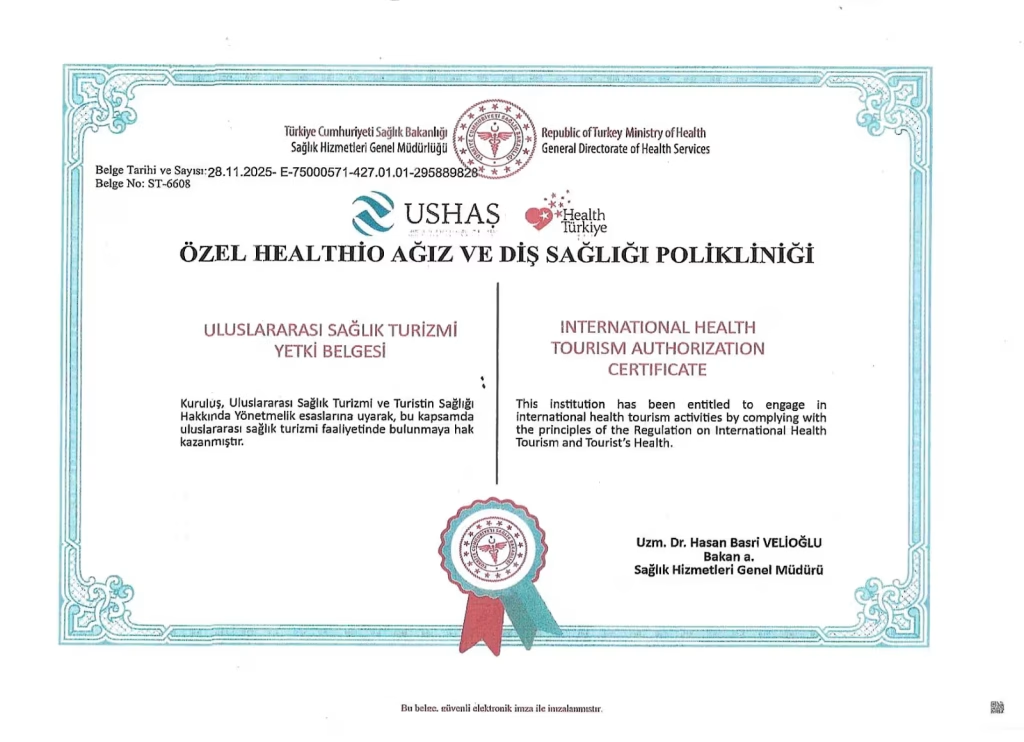
Turkey’s Ministry of Health (T.C. Sağlık Bakanlığı) operates a mandatory certification programme for all clinics legally permitted to treat international patients. The International Health Tourism Authorisation Certificate (Uluslararası Sağlık Turizmi Yetki Belgesi) requires facilities to demonstrate compliance with standards covering staffing qualifications, sterilisation protocols, equipment standards, patient rights protections, and complaint resolution procedures.
In April 2025, Turkey updated its health tourism regulatory framework through Official Gazette No. 32882 (published April 26, 2025), strengthening oversight requirements and tightening the annual certification renewal process for international patient facilities.
The complete list of currently certified clinics is maintained on the official HealthTurkiye portal — Turkey’s government health tourism authority. You can cross-reference any specific clinic against the Ministry of Health’s authorised healthcare providers database in less than five minutes.
Leading clinics also hold voluntary international quality certifications including ISO 9001:2025 and compliance with EU Medical Device Regulation (EU MDR). These are additional signals of a clinic’s commitment to international standards.
Before any treatment begins, confirm in writing:
- The specific procedure planned for each tooth (veneer, not crown)
- The material being used (brand or ceramic type)
- Whether the approach is genuinely no prep or minimal prep
- The dentist’s qualifications and registration status
- The aftercare channel available after you return home
Every clinic in the healthioturkey.com network holds current Ministry of Health authorisation. You can also explore the dental implants page if implant treatment is part of your broader dental plan during the same trip.
5 Mistakes That Shorten Your No Prep Veneers Lifespan
These restorations are durable — but they are not indestructible. The most common reasons for premature failure are entirely avoidable.
1. Using abrasive toothpaste. Charcoal toothpastes, baking soda formulas, and “whitening” pastes with high-abrasivity ratings scratch the glaze on the veneer surface over time. This dulls the finish and increases staining susceptibility. Use only non-abrasive fluoride toothpaste — your dentist can recommend a specific product.
2. Ignoring bruxism without a night guard. Patients who clench or grind their teeth at night expose their 0.2–0.3 mm veneers to forces they are not designed to withstand. A custom-fitted night guard is not optional for bruxism patients — it is essential for protecting the restoration. If you suspect you grind your teeth, discuss this during your consultation before treatment begins.
3. Rushing the shade selection. These veneers are fabricated to match a specific shade chosen during consultation. Patients who select a shade under artificial lighting, without considering how it looks in natural daylight, often find the result too bright or too grey in everyday settings. Take time with this decision — the laboratory cannot adjust the shade after bonding.
4. Neglecting gumline hygiene. The junction where a veneer meets the gumline is a common site for bacterial accumulation. Standard brushing does not always reach this area effectively. Use a soft-bristled brush angled toward the gumline, and floss daily. A water flosser (Waterpik) used regularly is particularly effective at clearing debris from the veneer margin.
5. Expecting too much correction. Prepless veneers correct minor cosmetic issues exceptionally well. They cannot replace orthodontic treatment for misaligned teeth, bleach severe staining, or reconstruct structurally damaged teeth. Patients with unrealistic expectations are the most common source of dissatisfaction — which is why a thorough pre-treatment consultation, including Digital Smile Design, protects both the patient and the clinical outcome.
Aftercare: How to Make Them Last 15+ Years
With the right daily habits and professional maintenance schedule, no prep porcelain veneers regularly achieve their full expected lifespan — and often exceed it.
Daily oral hygiene:
- Brush twice daily for a minimum of two minutes using a soft-bristle toothbrush and non-abrasive fluoride toothpaste
- Floss daily, paying close attention to the veneer margin at the gumline
- Rinse with an alcohol-free mouthwash — alcohol-based formulas can weaken the resin cement bond over time
Dietary habits:
- Limit coffee, red wine, tea, and dark berries, or drink them through a straw to minimise surface contact during the first few weeks after bonding
- Avoid very hard foods (crusty bread, ice, hard sweets, raw carrots) that could chip a thin ceramic shell
- Do not use your veneered teeth as tools for opening packaging or biting nails
Professional maintenance:
- Attend professional cleanings twice per year and inform your hygienist that you have porcelain veneers — they should use hand scalers around veneer margins rather than ultrasonic instruments, which can disrupt the bond
- Schedule annual X-rays to check for any cavity development at the veneer edges
If something concerns you: Contact your clinic’s aftercare channel directly. A high bite detected early is a five-minute adjustment. Left for months, a misaligned bite can fracture the veneer entirely. Prompt communication protects your investment.
To discuss aftercare protocols before your appointment or to get matched with a certified clinic, contact the healthioturkey.com team — free consultation, response within 24 hours.
Conclusion
No prep veneers represent the clearest example of how modern cosmetic dentistry has moved toward preserving rather than sacrificing natural tooth structure. The clinical evidence — including a landmark 9-year comparative study showing that no prep survival rates exceed those of conventional veneers — validates the approach for appropriate candidates.
The key phrase is “appropriate candidates.” No prep veneers work brilliantly for patients with minor cosmetic corrections and healthy enamel. They are not a universal solution. Correct patient selection, quality materials, and an experienced clinical team determine the outcome more than any other variable.
Turkey offers that clinical quality at 60–75% below Western prices, in a regulated environment that has strengthened its patient protections through the 2025 Ministry of Health framework update. A 5-day trip is all it takes.
The next step is a consultation — one that begins with an honest assessment of whether no prep veneers are genuinely right for your teeth. Contact healthioturkey.com to receive a personalised treatment plan and cost estimate within 24 hours.
FAQ
How long do no prep veneers last?
Porcelain no prep veneers typically last 10–15 years with proper care. A 9-year PMC clinical study found their survival rate exceeded that of conventional prepared veneers. Ultra-thin zirconia no prep veneers showed a 99.5% survival rate at 24 months in a recent retrospective study. Composite no prep veneers last 5–7 years on average.
Are no prep veneers reversible?
Yes. Because no prep veneers require zero enamel removal, the underlying tooth remains completely untouched. If you ever choose to have them removed, your natural teeth are exactly as they were before treatment. This is one of their most significant clinical advantages over traditional veneers, which permanently alter tooth structure.
Who is NOT a good candidate for no prep veneers?
Patients with severe bruxism, severely misaligned or prominent teeth, significant discoloration more than two shades above the whitening scale, insufficient enamel, or active gum disease are generally not suitable candidates. Clinical research suggests only 4 in 10 veneer cases are appropriate for the no prep approach — a thorough pre-treatment assessment determines suitability.
How much do no prep veneers cost in Turkey?
No prep porcelain veneers in Turkey cost $450–$970 per tooth, compared to £800–£1,500 per tooth in the UK and $1,200–$2,500 in the US — a saving of 60–75%. All-inclusive packages covering consultation, digital smile design, bonding, hotel accommodation, and airport transfers are widely available from Ministry of Health-certified clinics.
What does a typical Turkey no prep veneers trip look like?
Most patients complete the full process in 5 days: Day 1 arrival and rest, Day 2 consultation and digital smile design with enamel conditioning, Days 3–4 laboratory fabrication while exploring the city, Day 5 final bonding and departure. No anaesthesia or recovery time is required in most cases, making this one of the most efficient dental tourism trips available.