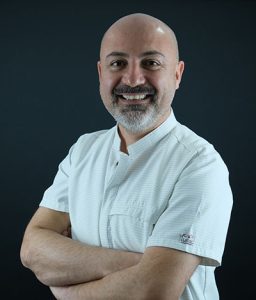

Medically reviewed by Alpaslan Burak Zorlu, dentist, M.Sc. Implantology and Dental Surgery · Last updated: October 2026 · Editorial contact: info@healthioturkey.com
You can check Turkish dentists yourself before you book: confirm the dentist’s registration with the Turkish Dental Association, the clinic’s Ministry of Health authorisation for international patients, and the written treatment plan, implant details and warranty terms you receive before you travel.
None of these checks needs inside knowledge. This checklist shows where to look, what to ask for in writing and what the answers tell you.
Key points
- There is no official ranking of dentists or clinics in Turkey; you judge them by checks you can verify.
- Dentists in private practice must be registered with their regional dental chamber, which you can check by name.
- Clinics treating international patients need a Ministry of Health authorisation certificate, listed on official websites.
- A written plan with tooth numbers, materials, the named dentist and warranty terms should come before you travel.
Why is checking a dentist in Turkey different from checking one in the UK?
Because the UK register does not cover Turkey: in the UK you search the General Dental Council (GDC) register, but Turkish dentists are registered and supervised by Turkish bodies, in Turkish. The GDC itself notes that other countries may have no equivalent regulator, or different standards.
What you read is also rarely neutral. Many clinic websites use sales language, while some UK coverage leans on fear; a 2025 review of UK newspaper reporting found that tabloids often stigmatised people who had dentistry abroad. The GDC’s guidance is more practical: research the country’s regulation, ask who will treat you and ask what happens if something goes wrong. The full checklist is below, with each point explained afterwards.
| # | What to check | Where or how to verify it |
|---|---|---|
| 1 | The dentist is registered to practise | Turkish Dental Association (TDB) “Dişhekimi Bul” search |
| 2 | Qualifications and any specialist title | Copies of diploma and specialty certificate |
| 3 | The clinic holds a Ministry of Health licence | Licence document and number from the clinic |
| 4 | International health tourism authorisation | Ministry of Health authorised-facility lists |
| 5 | Who will actually treat you | Named dentist in your written plan |
| 6 | An examination and X-rays before the final plan | Plan marked provisional until you are examined |
| 7 | A written plan with tooth numbers and materials | The plan document itself |
| 8 | Implant brand, system and an implant passport | Plan and passport sample |
| 9 | Written warranty terms | The warranty document, before you pay |
| 10 | Aftercare and complaints process | Written aftercare and complaints procedure |
| 11 | Accreditations and reviews checked at source | The accrediting body’s own register |
| 12 | No red flags | The list at the end of this guide |
Is the dentist qualified and registered to practise in Turkey?
A dentist practising in Turkey must hold a dental degree, and under the Turkish Dental Association Law (No. 3224) dentists who practise independently must register with the dental chamber of their province within a month of starting. The chambers belong to the Turkish Dental Association (Türk Dişhekimleri Birliği, TDB), whose website has a public “Dişhekimi Bul” (find a dentist) search.
- Ask the clinic for the full name of each dentist exactly as it appears on their diploma.
- Search that name on the TDB “Dişhekimi Bul” page, which is in Turkish.
- Check that the dentist appears and that the province or chamber matches where the clinic is.
- Ask for a copy of the diploma, showing the university and year.
Dentists who work only in public institutions are not required to join a chamber, so a missing entry is a reason to ask, not proof of a problem. A clinic that will not tell you who its dentists are is a different matter.
Is the clinic licensed by the Ministry of Health and authorised for international patients?
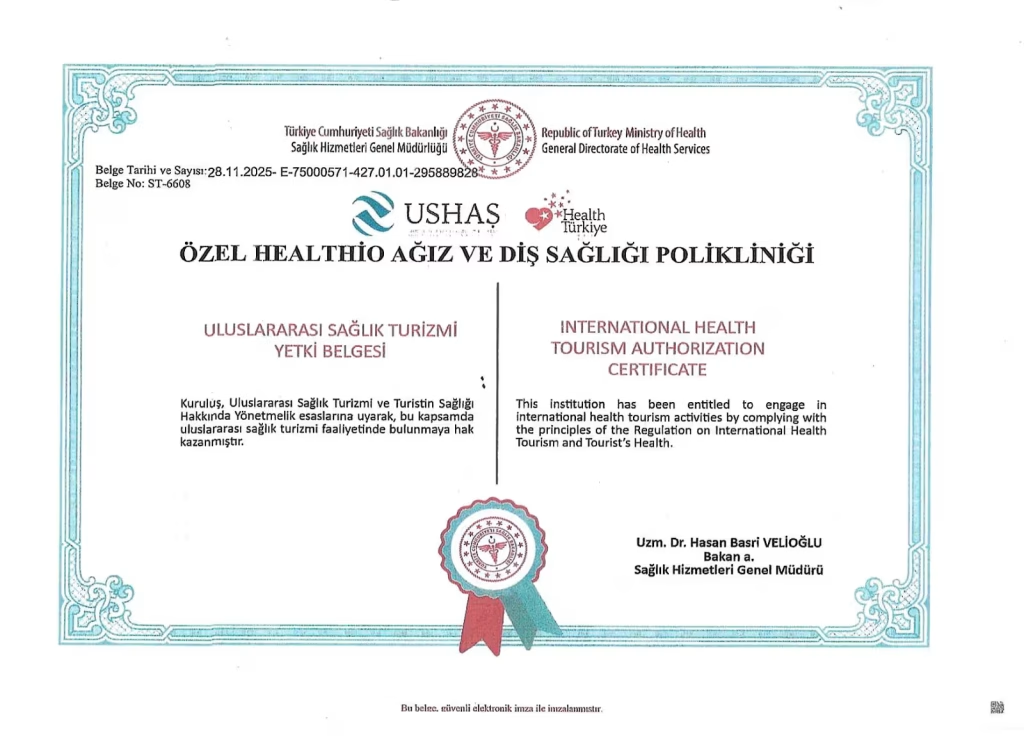
A private dental clinic in Turkey operates under a licence issued through the Ministry of Health, and a clinic that treats international patients also needs the Ministry’s International Health Tourism Authorisation Certificate (Uluslararası Sağlık Turizmi Yetki Belgesi). These are two separate checks.
The Ministry’s Health Tourism Department publishes lists of authorised health facilities and authorised intermediary organisations, and provincial health directorates, such as Antalya’s, publish lists for their area. When we checked, the national lists had last been updated on 20 August 2026.
- Ask the clinic for its legal name, because the name on official lists can differ from the brand name on its website.
- Ask for the licence and the authorisation certificate, with their numbers.
- Find the clinic on the Ministry’s list of authorised health facilities.
- If you are booking through an agency or facilitator, check that it appears on the separate list of authorised intermediary organisations.
HealthTürkiye, the Ministry of Health’s portal for international patients, is a further place to look, but the Ministry’s authorisation lists are the primary record.
Who will actually carry out your treatment, and what qualifications do they hold?
You are entitled to know, in writing, which dentist will plan your treatment and which will carry it out. They are not always the same person, and the GDC suggests asking any overseas clinic exactly this: who will carry out your treatment and what qualifications they have.
- Planner and treating dentist. If an online consultation is done by one dentist and treatment by another, ask for both names and check both.
- Specialist titles. Turkey recognises a defined set of dental specialties, such as prosthodontics, periodontology and oral and maxillofacial surgery, each requiring formal specialty training. Ask for the specialty certificate if someone is described as a specialist.
- Postgraduate degrees. A master’s degree or course in implantology is a qualification, not a specialist title; implantology is not a recognised dental specialty in Turkey or the UK.
You can see who works at our clinic on the page about our dentists in Antalya, and read the qualifications of our responsible dentist on the profile of Alpaslan Burak Zorlu.
Will you receive a written treatment plan with tooth numbers and materials before you travel?
You should. The GDC says you should always be assessed by a qualified dentist before being given a treatment plan and cost estimate, and a plan made from photos can only be provisional. Suitability for crowns, veneers or implants is decided only after an examination and X-rays, ideally including a CBCT scan where implants are planned.
A useful written plan includes:
- each tooth by number (Turkey uses the two-digit FDI system) and what will be done to it;
- the material for each crown, veneer or filling, for example zirconia, e.max or composite;
- less invasive alternatives, such as bonding or veneers instead of crowns, and why they are or are not suitable;
- the number of visits, the days between them and whether a second trip is needed;
- the main risks, such as irreversible tooth reduction for crowns or implant failure;
- the name of the treating dentist and the total cost, including anything you must pay separately.
If the plan changes after your examination, the clinic should explain why in writing.
Which implant brands and materials are used, and will you receive an implant passport?
A clinic should name the implant manufacturer and system in your plan before treatment, and give you an implant passport afterwards. Implant parts are system-specific, so a dentist in the UK who does not know your system may not be able to replace a screw or abutment.
An implant passport should record, for each implant:
- manufacturer, system and product line;
- diameter, length and connection type;
- batch (lot) number and placement date;
- abutment type and the crown material.
We use Straumann and MegaGen (AnyRidge) implant systems and record them in this way. Whatever clinic you choose, ask for a sample passport before you book so that you know what you will receive.
What does the written warranty cover, and what happens if something goes wrong once you are home?
A warranty is only as useful as its written terms, so read them before you pay. The GDC suggests asking whether the work is covered for a set period and who pays for extra flights, hotel and remedial work if you are unhappy with the result.
- How long cover lasts for each type of work.
- Which check visits you must attend, and where, to keep it valid.
- Who pays travel and accommodation for a repair visit.
- Whether work by a UK dentist is covered, refunded or excluded.
- Exclusions, such as accidents or teeth grinding.
If something goes wrong at home, see a UK dentist first for pain, swelling or infection. The NHS Business Services Authority says an NHS practice that accepts you must provide clinically necessary treatment, but the NHS arrangements for repairing or replacing its own work at no charge do not apply to treatment done abroad. Healthio has no UK practice or partner; our follow-up is remote and through planned check visits in Antalya.
What do accreditations and online reviews tell you, and what do they not?
Accreditations and reviews tell you about systems and service, not about the outcome of your own treatment. Neither replaces the official checks above.
| Signal | What it can tell you | What it cannot tell you |
|---|---|---|
| ISO 9001 certificate | The clinic runs a documented quality management system | Clinical results or the skill of individual dentists |
| International accreditation schemes | An external body assessed set standards at a point in time | Whether that applies to the dental clinic you visit, unless the scope says so |
| Online reviews | How communication, organisation and service felt to others | How the work will look or last years later |
Check any accreditation on the accrediting body’s own website, including its scope and expiry date. With reviews, look at how they are spread over time, whether they describe specific treatment and how the clinic responds to complaints.
Which red flags should make you pause before booking?
Pause if a clinic pressures you, will not put things in writing or cannot show documents you can verify. The NHS lists a hard sell, a lack of information, pressure to decide quickly, no discussion of possible complications and no mention of aftercare as reasons to think carefully about treatment abroad.
- A full set of crowns proposed from photos alone, without discussing veneers, bonding or no treatment.
- No named dentist, or a name you cannot find on the TDB search.
- No licence or authorisation certificate number, or a clinic missing from the Ministry’s lists.
- An agency that is not on the list of authorised intermediary organisations.
- Warranty promises that exist only verbally, or “lifetime” cover without written terms.
- Claims of a UK office or partner practice that you cannot verify.
Treatment in Turkey is also not suitable for everyone: if you have active gum disease, cannot attend follow-up visits or need complex medical support, a dentist may advise treatment nearer home. That decision is made only after an examination.
Frequently asked questions
Is there a “best dentist in Turkey” – and how can you judge one yourself?
No official body ranks dentists or clinics in Turkey, so searches such as “best dental clinic in Turkey for implants” return marketing lists, not assessments. Judge a dentist on what you can verify: registration, the clinic’s authorisation, a written plan after examination, a named treating dentist and clear warranty terms.
How can I check that a Turkish dentist is registered?
Ask the clinic for the dentist’s full name as written on the diploma and the chamber they belong to. Then search the name on the Turkish Dental Association’s “Dişhekimi Bul” page. If you cannot find them, ask the clinic to explain, for example whether the dentist works mainly in a public institution.
What is the Ministry of Health authorisation for health tourism, and how do I check it?
It is the International Health Tourism Authorisation Certificate, which facilities treating international patients must hold. The Ministry of Health’s Health Tourism Department publishes the lists of authorised facilities and intermediary organisations. Ask for the clinic’s legal name and certificate number, then look for it on the current list.
Should a clinic in Turkey send me a treatment plan before I travel?
Yes, a provisional written plan based on your X-rays or photos, with an explanation of what may change after the examination. It should not be final until a dentist has examined you in person. If a clinic will not put anything in writing before you travel, that is a reason to pause.
Is a clinic with hundreds of five-star reviews a safe choice?
Not on that basis alone. Reviews mostly describe service and the first weeks after treatment, while problems with crowns or implants can appear years later. Some reviews are not genuine. Use reviews as one signal alongside registration, authorisation and a clear written plan, never instead of them.
What can I do if something goes wrong after I return to the UK?
For pain, swelling or infection, see a UK dentist or call NHS 111 for urgent dental care. Then contact the treating clinic with photos and any X-rays, and follow the process in your written warranty. If you are unhappy with how a complaint is handled, use the clinic’s written complaints procedure.
Summary
Checking Turkish dentists comes down to evidence you can verify: the dentist’s chamber registration, the clinic’s Ministry of Health licence and health tourism authorisation, a named treating dentist, and a written plan, implant passport and warranty before you travel. Accreditations and reviews add context but do not replace these checks.
If you would like us to review your situation, send your X-rays or photos for an assessment and a written treatment plan through our contact page. For background on the treatments people travel for, see our guide to Turkey teeth.
Plan your treatment with Healthio Turkey
Send us your X-rays or a few photos of your teeth. Our dentists in Antalya review them and send you a written treatment plan with the price. Whether a treatment suits you is confirmed at your examination.
Sources
- General Dental Council. Going abroad for dental treatment. Undated, accessed 2026. gdc-uk.org
- NHS. Treatment abroad checklist. 2023. nhs.uk
- NHS Business Services Authority. What can I provide a patient on the NHS who has just recently returned after having dental treatment abroad? Undated, accessed 2026. faq.nhsbsa.nhs.uk
- Republic of Türkiye Ministry of Health, Health Tourism Department. Authorised health facilities and intermediary organisations (Sağlık Turizmi Daire Başkanlığı). 2026. shgmturizmdb.saglik.gov.tr
- Republic of Türkiye Ministry of Health. HealthTürkiye. 2026. healthturkiye.gov.tr
- British Dental Journal (Doughty J et al.). Contemporary dental tourism: a review of reporting in the UK news media. 2025. pubmed.ncbi.nlm.nih.gov