
Medically reviewed by Alpaslan Burak Zorlu, dentist, M.Sc. Implantology and Dental Surgery · Last updated: November 2026 · Editorial contact: info@healthioturkey.com
Standard travel insurance does not normally cover dental treatment you travel abroad to have. It is designed for unexpected emergencies, so dental travel insurance for planned treatment means a policy that names the treatment and its complications, and an insurer who knows why you are travelling.
This guide does not recommend any insurer. It explains the types of cover, the usual exclusions, why a GHIC does not help in Turkey, and who pays if something goes wrong at home.
Key points
- Standard policies cover sudden emergencies, not treatment you planned before you left.
- Dedicated medical travel policies may cover complications of planned treatment, within limits and time windows.
- The GHIC and EHIC are not valid in Turkey.
- Insurance, the clinic’s written warranty and the NHS each cover different problems, and some problems fall to none of them.
Does standard travel insurance cover dental treatment abroad?
No, not usually. The Foreign, Commonwealth and Development Office (FCDO) warns that standard travel insurance does not normally cover you if you travel abroad for elective surgery, and that cover may not apply to costs arising from complications. Planned dental treatment such as implants, crowns or veneers falls into the same category.
- Covered in many standard policies: sudden illness or injury, emergency pain relief, travel disruption.
- Usually excluded: planned treatment, its complications and corrective work.
- At risk if undeclared: the whole policy, if you do not tell the insurer the purpose of the trip.
Emergency dental cover vs cover for planned treatment: what is the difference?
Emergency dental cover pays for sudden, unforeseen problems during a trip; cover for planned treatment pays for complications of a procedure you booked in advance. They are different products.
| Feature | Emergency dental cover | Cover for planned treatment |
|---|---|---|
| Typical trigger | Abscess, broken tooth, lost crown or accident during the trip | Complication of the treatment you travelled for |
| What it usually pays | Short-term pain relief or temporary repair, often with a low sub-limit | Treating the complication, sometimes extra nights and changed flights |
| Where it is found | Many standard travel policies | Dedicated medical travel or complications policies |
Some people search for “dental holiday insurance”, but the trip is a treatment trip and should be described to an insurer as exactly that.
What can medical travel insurance for dental treatment include?
Medical travel insurance for dental treatment is designed to cover specified complications of a planned procedure, which standard policies leave out. Policies differ widely, so treat the list below as features to look for, not a description of any particular product.
- Treatment of a complication that arises while you are still abroad.
- Extra accommodation and changed flights if a complication means you must stay longer.
- Corrective treatment after you return home, usually only for a set number of days or months.
- Repatriation or travel for a companion in serious cases.
- Overall limits per claim, and separate, lower limits for dental work.
What is usually not covered?
Dissatisfaction with how your teeth look is usually not covered by any travel or medical travel policy, and neither are several other common situations.
- Cosmetic dissatisfaction, colour or shape preferences.
- Expected side effects such as swelling, bruising or temporary sensitivity.
- Pre-existing conditions you did not declare.
- Problems caused by not following aftercare instructions, or by flying earlier than advised.
- Claims linked to excessive alcohol, or travel against FCDO advice.
- Routine maintenance, such as later hygiene appointments.
Does a GHIC or EHIC cover dental treatment in Turkey?
No. The FCDO’s travel advice for Turkey states that the European Health Insurance Card and Global Health Insurance Card are not valid there, because Turkey is outside the countries covered by the scheme.
Even where it is valid, the NHS explains that the card covers only state healthcare that cannot reasonably wait until you return, and is not a replacement for travel insurance.
- In Turkey: no GHIC or EHIC cover at all, so emergency care is private and paid for by you or your insurer.
- In EEA countries and other covered areas: state emergency care only, never planned dental treatment.
What should you check in a policy before you book treatment?
Check that the policy explicitly accepts travel for treatment and defines what it pays for afterwards. The FCDO notes that failing to declare something may invalidate your travel insurance, and the NHS advises telling your insurer about your plans to have treatment abroad.
- Purpose of travel: does the policy accept trips made for dental treatment, or exclude them?
- Definition of complication: what counts, and what is treated as an expected side effect?
- Time window: how many days or months after treatment does cover last?
- Corrective treatment at home: is it covered in the UK, by whom and up to what limit?
- Extended stay and flights: are extra nights and changed flights paid if a complication delays you?
- Declarations: which medical conditions, medicines and planned procedures must you declare?
- Documents: what does the insurer need from the clinic, such as the treatment plan, clinical notes, X-rays, invoices and a written report?
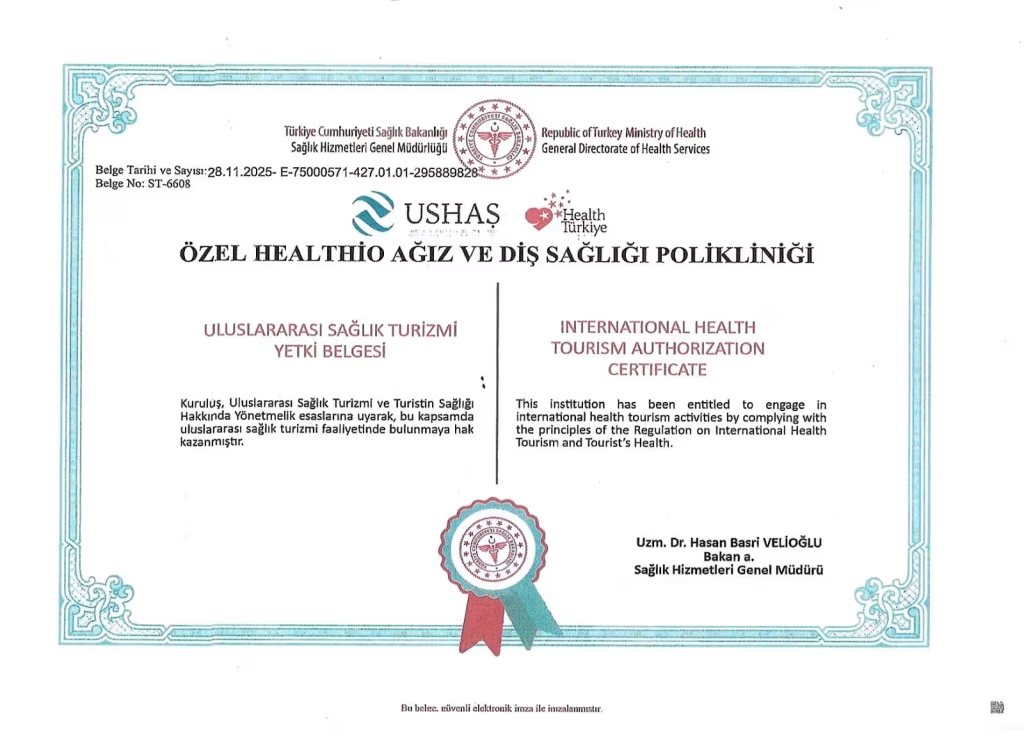
- Clinic requirements: must the clinic be licensed by the Turkish Ministry of Health or hold a specific authorisation?
Also ask the clinic in writing when you can fly after each stage, as the date may be later after bone grafting or a sinus lift. If a cancelled flight moves your treatment schedule, check whether travel disruption cover pays for extra nights and whether the written plan allows appointments to be rescheduled.
Insurance, clinic warranty or NHS: who pays if something goes wrong after you return?
It depends on the problem: insurance pays only for defined medical events within its time window, the clinic’s warranty covers the work under its written terms, and the NHS provides urgent care but is not obliged to repair or replace private work done abroad.
| Problem | Standard travel insurance | Medical travel policy | Clinic warranty and plan | NHS in the UK |
|---|---|---|---|---|
| Infection while still in Turkey | Usually excluded | Often covered, within limits | Managed by the treating clinic | Not applicable |
| Implant fails to integrate after you return | No | Possibly, if within the time window | As set out in the written warranty terms | Urgent stabilisation only |
| Crown breaks or comes loose at home | No | Rarely | As set out in the written warranty terms | Urgent care at the normal band charge; not obliged to replace it |
| Unhappy with how teeth look | No | Usually excluded | Discussed with the clinic; depends on the written terms | No |
| Severe pain or swelling after return | No | Possibly | Remote advice, possibly a return visit | Urgent assessment and stabilisation |
NHS England’s policy says patients treated privately abroad can access NHS care to assess and stabilise an urgent problem, but care the NHS would not routinely fund is not usually replaced. Our guide on whether UK dentists will fix Turkey teeth covers this in more detail.
Written warranty terms come with your treatment plan, and our page on dental implant warranties in Turkey explains what to look for. A warranty covers the work and materials under its stated conditions; it does not pay for flights, hotels or treatment elsewhere unless the terms say so.
What should you do if you have a dental problem while you are in Turkey?
If the problem relates to your treatment, contact the treating clinic first; if it is a medical emergency, dial 112 for an ambulance. Then contact your insurer’s assistance line, ideally before you pay for further care.
- Call the clinic or your patient coordinator and describe the symptoms.
- For breathing difficulty, rapidly spreading swelling or heavy bleeding, dial 112.
- Contact your insurer’s emergency assistance number and note the claim reference.
- Keep every invoice, receipt and booking change, including extra hotel nights and flights.
- Ask for a written clinical report in English, with X-rays and a list of what was done.
Take copies of all records home: they support a claim and show any UK dentist what was placed. Our guide to Turkey teeth covers planning and aftercare.
Frequently asked questions
Will my travel insurance be invalid if I go abroad for dental work?
Not necessarily invalid, but it may not cover anything connected with the treatment. The bigger risk is non-disclosure: if you do not tell your insurer the purpose of the trip, it may refuse claims or cancel the policy. Ask in writing whether the policy still applies to the rest of your trip.
Does travel insurance cover a lost crown or broken tooth while travelling?
Many standard policies include emergency dental cover for sudden problems such as a lost crown or broken tooth, usually limited to pain relief or a temporary repair up to a modest sub-limit. Permanent repair is normally left until you return home. If the crown was placed during the trip, a standard policy is unlikely to pay.
Am I covered if I am unhappy with how my teeth look after treatment?
Almost certainly not by insurance. Travel and medical travel policies cover defined medical events, not aesthetic preferences. Agree shape and colour with the clinic before final fitting, keep the written treatment plan, and read the warranty terms, which describe what the clinic will and will not redo.
Am I covered if a complication means I have to stay longer in Turkey?
A standard policy usually will not pay for extra nights caused by planned treatment. A medical travel policy may cover extra accommodation and changed flights if the complication meets its definition. Keep receipts and a written clinical report explaining why the stay was extended.
Do I need to tell my insurer that I am travelling for dental treatment?
Yes. Declaring the purpose of the trip and any relevant medical conditions is what keeps the policy valid. Government guidance warns that failing to declare can invalidate travel insurance. Ask for confirmation in writing, so you know what is and is not covered before you pay a deposit.
Can I fly home straight after implant surgery?
It depends on what was done. Government guidance notes that flying after major surgery raises the risk of blood clots, and after bone grafting or a sinus lift your dentist may advise a longer wait because of pressure changes in the sinuses. Your written plan should state the earliest flying date, decided after examination.
Summary
Standard travel insurance covers emergencies, not treatment you travel for, and a GHIC does not apply in Turkey. Dedicated medical travel cover may help with complications; the clinic’s warranty and the NHS each cover narrower ground.
If you would like to know what documents an insurer may ask for, contact us before you book.
Plan your treatment with Healthio Turkey
Send us your X-rays or a few photos of your teeth. Our dentists in Antalya review them and send you a written treatment plan with the price. Whether a treatment suits you is confirmed at your examination.
Sources
- Foreign, Commonwealth and Development Office (GOV.UK). Turkey travel advice: health. 2026. gov.uk
- Foreign, Commonwealth and Development Office (GOV.UK). Medical emergencies, treatment and hospitalisation abroad. 2024. gov.uk
- Foreign, Commonwealth and Development Office (GOV.UK). Foreign travel insurance. Accessed 2026. gov.uk
- NHS. Get healthcare cover abroad with a UK GHIC or UK EHIC. Accessed 2026. nhs.uk
- NHS. Treatment abroad checklist. Accessed 2026. nhs.uk
- NHS England. Avoidance of doubt: clinical policy for self-funded dental treatment requiring NHS intervention. 2024. england.nhs.uk