Medically reviewed by Alpaslan Burak Zorlu, dentist, M.Sc. Implantology and Dental Surgery · Last updated: October 2026 · Editorial contact: info@healthioturkey.com
Turkey teeth gone wrong usually means crowns or veneers that cause ongoing pain, infection, gum problems, bite problems or an unnatural appearance, most often after healthy teeth were cut down for crowns. The causes are clinical, not geographical: too much tooth removed, an injured nerve, poor margins, a badly planned bite or a rushed timeline.
This guide links each warning sign to its likely cause and urgency, lists the records to ask for, and explains how to complain to a clinic in Turkey.
Key points
- Most problems trace back to five mechanisms: over-preparation, nerve injury, poor margins, bite errors and compressed timelines.
- Swelling, fever or spreading pain needs care the same day; most other signs can be assessed within days or weeks.
- Crowns can be replaced, but removed enamel never grows back.
- Ask for your X-rays, a tooth-numbered plan and material records before you leave the clinic.
- In Turkey, complaints can go to the clinic, the Ministry of Health’s SABİM line, the provincial health directorate and the regional chamber of dentists.
What Does “Turkey Teeth Gone Wrong” Usually Mean?
Turkey teeth gone wrong usually describes crowns or veneers that fail biologically, mechanically or cosmetically within months or a few years of treatment abroad. The phrase covers a wide range, from a crown that needs adjusting to teeth that cannot be saved.
In 2022 the British Dental Association (BDA) surveyed UK dentists about patients treated abroad. Most respondents had seen such patients, and most of those had treated cases that later developed problems. Crowns were the treatment most likely to need follow-up work, closely followed by implants. Dentists described over-prepared teeth, ill-fitting crowns, implants that fell out, and treatment carried out despite untreated gum disease.
Whether described as bad Turkey teeth, botched Turkey teeth or Turkey teeth fails, even the worst Turkey teeth problems fall into five groups:
- Biological: an inflamed or dead nerve, gum inflammation, decay under a crown, infection.
- Mechanical: a crown that comes loose, chips or fractures, or a tooth that breaks under it.
- Functional: a bite that feels wrong, pain on chewing, jaw ache or headaches.
- Aesthetic: teeth that look too white, too bulky or identical, or edges visible at the gum line.
- Process failures: no records, no named dentist, no route back to the clinic after flying home.
The underlying issue is usually treatment choice: crowns placed on healthy teeth to change their colour. How crowns differ from veneers, and how much tooth each removes, is explained in our main guide to what Turkey teeth are. This page explains mechanisms; it does not use other people’s cases or news photographs.
Why Do Turkey Teeth Go Wrong? Five Clinical Mechanisms
Turkey teeth go wrong through five mechanisms: over-preparation of healthy teeth, injury to the nerve, poor crown margins, errors in the bite, and a timeline too short for healing and checks. Each one can be identified by a dentist with an examination and X-rays.
1. Over-preparation of healthy teeth
A crown needs space on every side, so the tooth is reduced all round. On a healthy tooth, this removes enamel that will never return and leaves a smaller, weaker core. When teeth are reduced aggressively, they can end up as short, tapered stumps that hold a crown poorly and have little left to work with if the crown fails.
- What a dentist looks for: short or narrow cores on X-rays, exposed dentine where enamel bonding was intended, and loss of retention.
2. Nerve injury and the root canal chain
Cutting a tooth generates heat and brings the preparation closer to the pulp, the living tissue inside the tooth. A prospective study of 120 teeth prepared for crowns (Kontakiotis and colleagues, 2015) found that 9% developed pulp necrosis without symptoms by the time the crowns were cemented: 5% of intact teeth and 13% of teeth that already had decay, fillings or crowns.
The chain can continue for years. A nerve that dies under a crown may need root canal treatment through the crown or after removing it. The treated tooth is more brittle, and if it later fractures below the gum, it may have to be extracted.
- What a dentist looks for: no response to pulp testing, tenderness to tapping, or a dark area at the root tip on an X-ray.
3. Crown margins and the gum attachment
The margin is where the crown meets the tooth. Just above the bone there is a band of gum attachment, now called the supracrestal tissue attachment and previously the biologic width. A 2017 international consensus on periodontal classification, published in 2018, reported that placing restoration margins within this attachment is associated with inflammation and loss of the supporting tissues.
Margins can also fail when they are open, over-contoured or rough, letting plaque collect where you cannot clean. The result is gums that bleed, swell or recede around crowned teeth, with decay underneath.
- What a dentist looks for: bleeding confined to crowned teeth, a gap or step at the margin felt with an instrument, and overhangs or bone loss on X-rays.
4. Bite and vertical dimension
When many teeth are crowned at once, the whole bite is rebuilt. If crowns are made too high, contact unevenly or change how the jaws close, teeth can hurt on biting, ceramics can chip and the chewing muscles can ache. A planned increase in the height of the bite (the vertical dimension) can be appropriate for heavily worn teeth, normally tested with temporary restorations first. Raising it without a clear reason, simply to make teeth longer, commits more teeth to treatment.
The same 2018 consensus found no evidence that excessive bite forces cause gum recession, so receding gums around new crowns point first to the margins and gum health, not the bite.
- What a dentist looks for: marks showing early or heavy contacts, cracks in ceramic, tooth mobility and tender muscles.
5. Compressed timelines
Careful crown work includes temporaries, time for the gums to settle, a try-in, cementation and a bite check after the teeth have been used. Compressing a full-mouth treatment into a few days leaves little room for any of these. Implants add a healing period of several months before final teeth can be fitted, so honest planning for implants usually means more than one trip.
Planning also matters: a treatment plan should be made by the dentist who examines you, not by a coordinator working from photos. If you cannot name your treating dentist before you travel, you do not yet have a treatment plan.
- What to look for: no try-in, no temporaries, and no review appointment before you fly home.
Is the Problem the Country or the Treatment Plan?
The problem is mainly the treatment plan. Over-preparation, nerve injury, poor margins and bite errors happen wherever crowns are placed on healthy teeth without a clinical reason. Most accounts of Turkish teeth gone wrong would read the same if the crowns had been placed elsewhere. What travel adds is distance: aftercare is harder, timelines are shorter and complaints cross borders.
The BDA survey reflects this. Alongside clinical concerns, UK dentists raised continuity of care, difficulty obtaining redress or making a complaint, and communication between patients and practitioners. The GDC notes that its standards apply only in the UK and that regulation varies abroad.
| Factor | Why it matters | What to ask |
|---|---|---|
| Indication | Crowns on healthy teeth are the root of most problems | Why does each tooth need this restoration? |
| Who plans | Plans need a dentist’s examination | Who will examine and treat me? |
| Time on site | Rushed work skips try-ins and bite checks | How many appointments, and is there a try-in? |
| Price pressure | Unrealistically low prices often mean less laboratory work or chair time | What is included, and what could change it? |
| Follow-up | Problems often appear after you fly home | How do you handle a problem once I am back in the UK? |
Two commercial habits make things worse in any country. One is selling exactly what the patient asks for: an ethical response to a request for a celebrity smile is to discuss whitening, bonding or orthodontics first. The other is price-first decision making, because good dentistry has a cost floor everywhere.
Which Warning Signs Need Attention, and How Urgently?
Facial swelling, fever or throbbing pain need attention the same day; pain on biting, a loose crown or lingering sensitivity within a few days; bleeding gums, bad taste and food trapping within a few weeks. Mild sensitivity and tender gums in the first weeks after treatment are common and usually settle.
| Warning sign | Likely mechanism | How urgent | First step |
|---|---|---|---|
| Facial swelling, fever, pus or a bad taste with pain | Abscess from a dead or infected nerve, or gum infection | Same day | Urgent dental care; emergency services if swelling affects breathing, swallowing or the eye |
| Throbbing pain, worse at night or with heat | Inflamed or dying nerve | Within 1-2 days | Examination with X-rays and pulp testing |
| Pain when biting on one tooth | High contact, cracked crown or tooth, inflamed ligament | Within days | Bite check and adjustment; X-ray if it persists |
| Crown loose, clicking or fallen off | Cement failure, short core or decay underneath | Within days | Keep the crown; see a dentist rather than using household glue |
| Chipped or fractured ceramic | Overload, thin material or bite error | Days if sharp; otherwise weeks | Smoothing or repair; bite assessment |
| Sensitivity to cold that lasts or worsens | Exposed dentine or an inflamed nerve | Within 1-2 weeks | Examination and pulp testing |
| Bleeding or swollen gums around crowns | Plaque at open or bulky margins; margin within the gum attachment | Within weeks | Hygiene appointment and margin assessment |
| Bad taste or smell from one area | Leakage at a margin, decay under the crown, trapped food | Within weeks | Examination with X-rays |
| Food packing between two teeth | Open contact point between crowns | Within weeks | Contact check; adjustment or replacement |
| Jaw ache, headaches or clicking since treatment | Bite rebuilt at the wrong height or position | Within weeks; sooner if severe | Bite analysis; a protective splint may be considered |
Persistence and progression decide urgency. A symptom that is improving week by week is usually settling; one that stays the same or gets worse needs assessment.
What Should You Do First if Your Turkey Teeth Have Gone Wrong?
Deal with pain or infection first, then document the problem, contact the clinic in writing and get an independent examination before agreeing to any repair. Stabilising comes before appearance.
- Get urgent symptoms treated where you are. NHS England policy says patients who paid privately, in the UK or abroad, can access NHS care to assess and stabilise an acute problem; NHS dentists are not obliged to go further and repair or replace the private work, and the GDC advises telling your own dentist about treatment abroad.
- Document the problem. Note when each symptom started and how it has changed, and take clear photos of your teeth and gums.
- Contact the clinic in writing. Describe the symptoms, attach photos and any X-rays, ask for a written response and refer to your warranty terms.
- Request your records. The next section lists what to ask for.
- Get an independent examination. X-rays, and where needed a CBCT scan, show how much tooth remains, the state of each nerve and the bone level. Until then, any repair plan is guesswork.
- Stabilise before you restore. Infection, gum disease and failing nerves are treated before any cosmetic work is redone.
- Read before you sign. If the original clinic offers a revision or partial refund, check whether it comes with a waiver releasing it from further responsibility.
Which Records Should You Ask Your Clinic For?
Ask for copies of everything that describes your mouth before treatment, what was done to each tooth, with what materials, and on what terms. Ideally, ask before you leave the clinic; otherwise request them in writing.
| Record | Why it matters |
|---|---|
| Pre-treatment X-rays and CBCT scan (digital files) | Shows the condition of each tooth and the bone before treatment |
| Treatment plan by tooth number | Shows which restoration each tooth received and why |
| Clinical notes and consent forms | Shows what was discussed and done at each visit |
| Material and manufacturer of each restoration | Zirconia, E.max or composite need different repair and removal methods |
| Dental laboratory and shade code | Lets a replacement be matched |
| Cement type | Adhesive and conventional cements affect how a crown is removed |
| Implant details: system, diameter, length, lot number | Needed to source compatible parts anywhere |
| Post-treatment X-rays | Show margin fit and root fillings at the time of fitting |
| Itemised invoice and written warranty terms | Define what was paid for and what the clinic undertakes |
| Aftercare instructions and any splint prescription | Show what you were asked to do after treatment |
A UK dentist cannot plan a repair properly without most of these. Keep digital copies in more than one place.
What Can Be Corrected, and What Cannot Be Undone?
Restorations, bites and many infections can be corrected; removed enamel cannot be replaced, a dead nerve does not recover, and lost bone can be rebuilt only partly. Knowing which is which helps you set realistic expectations for any repair.
| Problem | Can it be corrected? | Usual approach |
|---|---|---|
| Poorly fitting or unnatural crowns | Yes | Remove, refine the preparation, remake with try-in |
| Bite at the wrong height or position | Usually | Adjustment, or new restorations after a trial phase |
| Inflamed gums at the margins | Often | Hygiene care; remaking margins; sometimes gum surgery |
| Dead or infected nerve | The nerve does not recover; the tooth often can be kept | Root canal treatment, then a new restoration |
| Removed enamel | No | The tooth needs a restoration for life |
| Gum recession | Partly | Gum grafting in selected cases |
| Bone loss | Partly | Bone grafting where an implant is planned |
| Tooth lost or unsalvageable | Replaceable, not restorable | Implant or bridge |
Each revision usually means removing a little more tooth, so options narrow over time. How long crowns last depends on margin accuracy, bite, gum health and maintenance, which is why a well-planned first restoration matters. If replacement crowns are needed, our page on dental crowns in Antalya explains how we plan them. What is possible for your teeth is decided only after an examination and X-rays.
How Can You Raise a Complaint With a Clinic in Turkey?
Start with a written complaint to the clinic, then use the official routes: the Ministry of Health’s SABİM communication centre, the provincial health directorate that licenses private clinics, and the regional chamber of dentists for professional conduct. Keep every step in writing.
- Write to the clinic. Set out the treatment, dates, symptoms and what you are asking for (assessment, repair, refund), with photos and records attached. Ask for a written reply within a stated time.
- Make a warranty claim. Quote the written warranty terms you received with your treatment plan. Our own terms are explained on our dental implant warranty page.
- Ask for the clinic’s complaints procedure. The GDC suggests asking for this before treatment; if you did not, ask now.
- Contact SABİM. SABİM is the Ministry of Health’s communication centre for requests and complaints about health services. It can be reached online or by dialling 184 from a Turkish phone line.
- Contact the provincial health directorate. Each province’s health directorate (İl Sağlık Müdürlüğü) oversees private health facilities in its area, including dental clinics.
- Contact the regional chamber of dentists. Turkish dentists belong to a regional chamber (Dişhekimleri Odası) under the Turkish Dental Association, which handles questions of professional conduct.
- Take legal advice if needed. For compensation claims, a lawyer in Turkey can explain the routes and any time limits.
The GDC regulates dental professionals working in the UK, so it cannot act on a dentist practising in Turkey. Turkish routes are the ones that can.
How Can You Reduce the Risk Before You Book?
Choose a clinic that diagnoses before it quotes, names your dentist, puts the plan and materials in writing, allows time for a try-in, and offers less invasive options before crowns. Ask every clinic the same questions and compare the written answers.
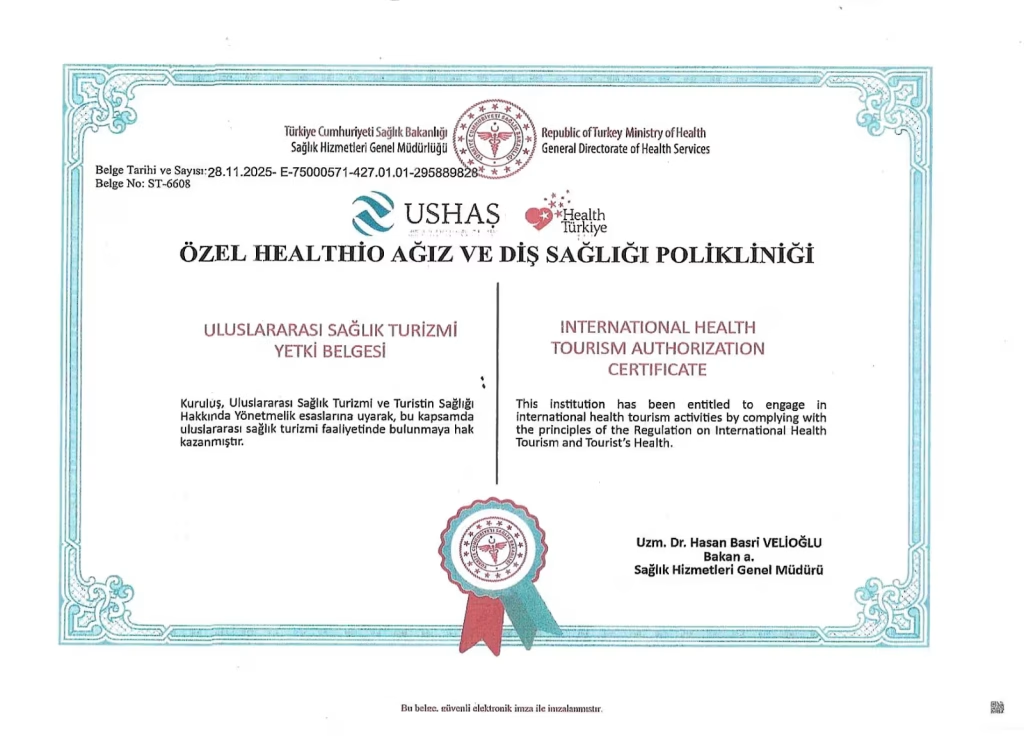
- Does the clinic hold the Ministry of Health’s international health tourism authorisation?
- Who is the treating dentist, and what qualifications do they hold?
- Which material and manufacturer will be used for each restoration, and will lot numbers be recorded for implants?
- Is the plan based on your own X-rays or CBCT scan, examined before treatment?
- What is in the written plan, and what could change it?
- How many appointments are needed, and is there a try-in and a bite check?
- What do the written warranty terms cover, and how are problems handled after you return home?
- Could your goal be reached with less tooth removal: whitening, bonding, veneers or orthodontics?
The last question matters most. A clinic that only ever recommends crowns is telling you something. Our guide to veneers in Turkey explains when veneers are a suitable alternative, and suitability for any option is confirmed only after an examination.
How we work
At Healthio Turkey in Antalya, treatment is the responsibility of Alpaslan Burak Zorlu, dentist, M.Sc. Implantology and Dental Surgery, working with Emre Karagöz and Şeval Ece Özgün. We use Straumann and MegaGen implant systems and record the brand of each restoration. We have no UK practice or partner: aftercare is remote follow-up, planned check visits in Antalya, written records you can show any UK dentist, and the written warranty terms in your plan.
Frequently asked questions
Why do my Turkey teeth hurt when I bite?
The most common reason is a crown that touches before the others, which overloads the ligament holding the tooth. A crack in the crown or tooth, or an inflamed nerve, can cause the same symptom. A bite check often solves the first quickly. If adjustment does not help within a few days, X-rays and pulp testing are needed.
Why do my gums bleed around my new crowns?
Gums are often tender for a few weeks after preparation. Bleeding that continues usually means plaque is collecting at the crown edges, either because the margins are open or bulky or because cleaning around them is difficult. Margins placed too deep can also keep the gum inflamed. A hygiene visit and a margin check are the first steps.
Can bad Turkey teeth be fixed?
Often, yes, although “fixed” usually means replaced rather than undone. Failing crowns can be remade, infected nerves treated with root canal treatment, and unsalvageable teeth replaced with implants or bridges. How much can be saved depends on the tooth structure remaining, which only an examination with X-rays, and sometimes a CBCT scan, can show.
Can shaved-down teeth grow back?
No. Enamel is made only while teeth are developing, so enamel removed during preparation does not regenerate, and the dentine underneath cannot rebuild the lost shape. A shaved-down tooth will always need a covering restoration. That is why the amount of tooth removed is the most important decision in cosmetic treatment.
Is it normal for new crowns to feel too big at first?
Some unfamiliarity is normal: the tongue and lips notice new contours, and speech may feel different for a week or two. A bite that feels high, or crowns that still feel bulky after a few weeks, is not something to wait out. High contacts can cause pain and chipping, so ask for a bite check.
Why do my Turkey teeth smell?
A persistent smell or bad taste from one area usually comes from bacteria where they cannot be cleaned: an open crown margin, decay under a crown, food trapped between crowns or gum inflammation. Less often it signals infection at a root. It needs an examination with X-rays within a few weeks, or sooner if there is pain or swelling.
Summary
Turkey teeth gone wrong is usually the result of a treatment plan rather than a country: crowns on healthy teeth, too much tooth removed, poor margins, an unplanned bite or a rushed schedule. Warning signs differ in urgency, records make any repair easier, and complaints in Turkey have clear official routes.
If you have concerns about existing work or are planning treatment, you can contact us and send your X-rays or photos for an assessment and a written treatment plan.
Plan your treatment with Healthio Turkey
Send us your X-rays or a few photos of your teeth. Our dentists in Antalya review them and send you a written treatment plan with the price. Whether a treatment suits you is confirmed at your examination.
Sources
- British Dental Association. UK dentists picking up the pieces from dental tourism boom. 2022. bda.org
- General Dental Council. Going abroad for dental treatment. Accessed 2026. gdc-uk.org
- NHS England. Avoidance of doubt: clinical policy for self-funded dental treatment requiring NHS intervention. 2024. england.nhs.uk
- Jepsen S, Caton JG, Albandar JM, et al. (Journal of Clinical Periodontology). Periodontal manifestations of systemic diseases and developmental and acquired conditions: consensus report of workgroup 3 of the 2017 World Workshop on the Classification of Periodontal and Peri-Implant Diseases and Conditions. 2018. pubmed.ncbi.nlm.nih.gov
- Kontakiotis EG, Filippatos CG, Stefopoulos S, Tzanetakis GN (International Endodontic Journal). A prospective study of the incidence of asymptomatic pulp necrosis following crown preparation. 2015. pubmed.ncbi.nlm.nih.gov
- Republic of Türkiye Ministry of Health. SABİM – ALO 184 Ministry of Health Communication Centre. Accessed 2026. sabim.gov.tr