Medically reviewed by Alpaslan Burak Zorlu, dentist, M.Sc. Implantology and Dental Surgery · Last updated: October 2026 · Editorial contact: info@healthioturkey.com
Dental implants in Turkey replace missing teeth with a titanium post placed in the jawbone and a crown attached to it, usually over two trips three to six months apart. The implant brand, your health and the records you take home matter as much as the price.
Reviewed by Alpaslan Burak Zorlu, a dentist with an M.Sc. in Implantology and Dental Surgery (University of Duisburg-Essen), this guide explains how implants work, who is a good candidate, how the two visits run and what you can check before you travel.
Key points
- An implant has three parts: the post in the bone, a connector (abutment) and the visible crown.
- Standard treatment takes two trips because the bone needs months to bond to the implant.
- The brand matters years later, when a UK dentist may need matching parts.
- Smoking, poorly controlled diabetes, gum disease and some bone medicines change the plan or the timing.
- You should leave with an implant passport naming the brand, size and batch number of every implant.
How Do Dental Implants Work? Implant, Abutment and Crown Explained
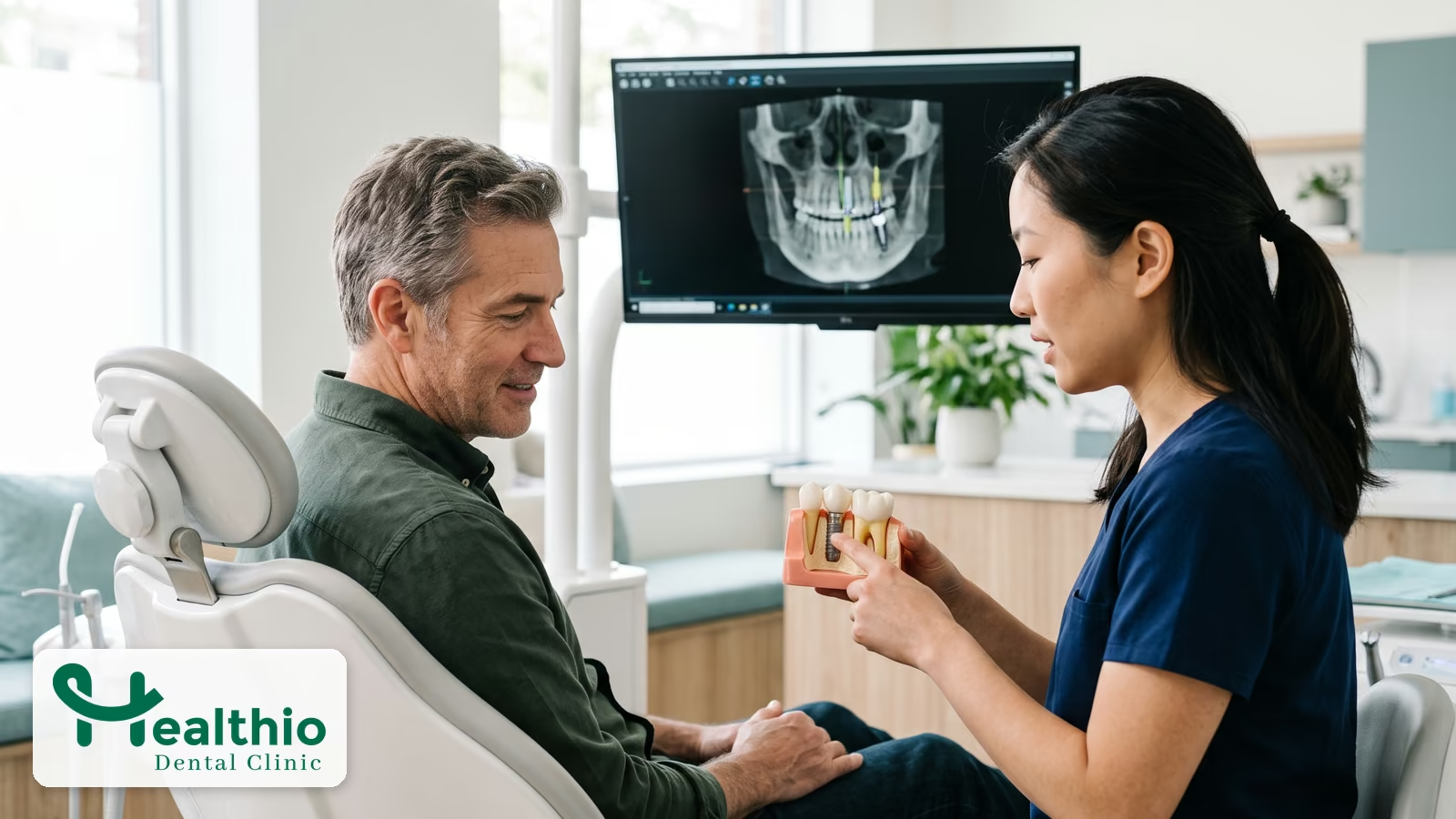
A dental implant works by acting as an artificial tooth root: a titanium post is placed in the jawbone, the bone grows onto its surface over several months, and a crown is then attached through a connector called an abutment.
- The implant: a screw-shaped titanium post placed in the jaw under local anaesthetic. Its surface is designed so that bone bonds to it, a process called osseointegration.
- The abutment: the connector that joins the implant to the crown. Its connection is specific to the implant system, which is why the brand matters later.
- The crown: the visible tooth, usually zirconia, either screwed or cemented onto the abutment. Several implants can also carry a bridge or a full arch of teeth.
Implants are not the same as what British media call “Turkey teeth”. That nickname usually refers to crowns or veneers fitted over natural teeth that have been filed down. The two treatments solve different problems:
| Crowns or veneers (“Turkey teeth”) | Dental implants | |
|---|---|---|
| What it treats | Teeth that are still present but discoloured, worn or chipped | Teeth that are missing or cannot be saved |
| Effect on your teeth | Enamel is reduced, permanently | Neighbouring teeth are not filed down |
| Trips to Turkey | Usually one | Usually two, months apart |
| Main risks | Sensitivity, nerve damage, root canal treatment | Infection, failure to integrate, nerve or sinus problems |
What a single implant costs
A single implant with abutment and zirconia crown costs from £550 with MegaGen AnyRidge or from £1,020 with Straumann (GBP, valid from October 2026). Included in the package price are the online consultation and treatment plan from your panoramic X-ray, the in-clinic examination, CBCT scan and digital X-rays, the treatment, materials and laboratory work, temporary teeth during healing, a 4-star hotel with breakfast (3 to 7 nights depending on treatment), private transfers between airport, hotel and clinic, and an English-speaking coordinator. Not included: flights for both trips (UK to Antalya return typically £80 to £200 each time), travel insurance, food and personal expenses beyond breakfast, and extra procedures only if the CBCT scan shows they are needed, such as a bone graft, sinus lift or extraction, which are itemised in the written plan. The final price is confirmed in writing after an examination and a CBCT scan. Our guide to dental implant costs in Turkey explains the price in detail, and our full mouth implant cost guide covers replacing all the teeth.
Which Implant Brands Are Used in Turkey, and Why Does the Brand Matter Back Home?
Clinics in Turkey use a wide range of implant systems, from long-established international brands to local and regional ones. We use two: Straumann and MegaGen AnyRidge. The brand matters back home because every system has its own connection, screws and tools, so a UK dentist can only repair or replace the crown easily if they know the system and can buy matching parts.
| System | Country of origin | Original parts in the UK | What to keep on record |
|---|---|---|---|
| Straumann | Switzerland | Sold through the manufacturer’s UK company and widely used by UK practices | Implant line, diameter, length, batch number |
| MegaGen AnyRidge | South Korea | Sold through a UK distributor; fewer UK practices use it routinely | As above, plus abutment type and screw |
| Other international systems | Various | Depends on the brand: ask before treatment | As above |
| Local or unbranded systems | Various | Often hard or impossible to source in the UK | Without a name and batch number, a repair becomes guesswork |
The difference between a premium and a value system is mostly the manufacturer, its research history, its distribution and its price. What protects you in the UK is knowing exactly what is in your mouth. Before you agree to treatment anywhere, ask for the manufacturer and the system name in writing, not a phrase such as “European quality implants”.
- Ask your UK dentist now whether they work with your intended system or can refer you to someone who does.
- Keep the implant passport and X-rays with your medical records.
- If your crown is screw-retained, record the screw type, because the screwdriver is system-specific.
Who Is a Good Candidate? Bone, Gum Health, Smoking and Medication
A good candidate for dental implants has enough healthy jawbone, gums without active disease and stable general health, and is willing to keep up cleaning and check-ups. Many conditions do not rule implants out but change the plan, the timing or the risk, which is why suitability is decided only after an examination and a CBCT scan.
| Factor | Why it matters | What we usually ask for or advise |
|---|---|---|
| Smoking | A systematic review found implant failure of 6.35% in smokers against 3.18% in non-smokers, with more infections and bone loss | Stop or cut down for several weeks around surgery; heavy smokers may be advised against implants |
| Diabetes | Well-controlled type 2 diabetes is associated with high implant survival; poor control slows healing | A recent HbA1c blood test result and a note from your GP if control is uncertain |
| Bone-strengthening medicines (antiresorptives) | Low doses for osteoporosis are associated with high implant survival; high doses for cancer that has spread to bone carry a high risk of complications | Tell us the medicine, the reason and how long you have taken it; high-dose treatment usually rules out implants abroad |
| Radiotherapy to the head or neck | Reduces implant survival and slows bone healing | Treatment planned with your cancer care team, usually at home rather than abroad |
| Active gum disease (periodontitis) | Bacteria around teeth can spread to implants | Gum treatment first, then implants once the gums are stable |
| Bone volume | Too little bone means the implant cannot be held securely | CBCT scan; a graft, sinus lift or different implant position may be needed |
The evidence on medical conditions comes largely from a 2018 systematic review by Schimmel and colleagues, which looked at implants in older adults and common health conditions. A separate ten-year review found implant survival slightly lower in people aged 65 and over, so age is discussed, although it is not a barrier on its own.
Who should not have implants abroad
- People who cannot make two trips or stay for the planned number of days.
- People with uncontrolled diabetes, untreated gum disease or a current infection in the jaw.
- Anyone receiving high-dose bone medicines for cancer, or who has had radiotherapy to the jaws.
- Heavy smokers who are not willing to stop around the time of surgery.
- Anyone whose teeth could reasonably be saved with gum treatment, root canal treatment or a crown.
Hiding a condition to be accepted for treatment only puts you at risk. A full medical history, including every medicine you take, is part of a safe assessment.
How Many Trips Do You Need? The Two-Visit Timeline Day by Day
Standard implant treatment needs two trips to Antalya: one to place the implants and one, about three to six months later, to fit the final crowns. The gap is biological: the bone needs time to bond to the implant, and it cannot be shortened by paying more.
First trip: about 5 to 7 days
- Day 1: transfer from the airport, examination, CBCT scan and digital X-rays; we go through the written plan and price with you before anything is done.
- Day 2: any extractions and implant surgery under local anaesthetic.
- Day 3: rest; a check of the wound and your comfort.
- Days 4 to 5: review, temporary teeth fitted or adjusted where needed, written aftercare instructions.
- Days 6 to 7: final check and flight home, if the dentist is happy with healing.
Between the trips: three to six months at home
- You wear temporary teeth if the gap is visible, usually a removable or bonded temporary.
- For the first weeks you eat soft food and avoid chewing on the implant site.
- We follow up remotely: you send photos at agreed points, and if we need an X-ray you can ask a UK dentist to take one at your own cost and send us the digital file.
- If something worries you, you contact the clinic directly and a dentist from our team replies in writing.
Second trip: about 5 to 7 days
- Day 1: check of the gums and an X-ray to confirm the implants have integrated.
- Day 2: abutments placed and a digital scan or impression taken for the laboratory.
- Days 3 to 4: the laboratory makes the crowns; a try-in for shape, shade and bite.
- Day 5: final crowns fitted and the bite adjusted.
- Days 6 to 7: review, your implant passport and records handed over, flight home.
Some people need a longer gap, for example after a bone graft. Your exact timeline is set in the written plan after the examination.
Are Same-Day Implants Possible, and Who Are They For?
Same-day dental implants in Turkey are possible for some patients, but what is fitted on the day is a temporary tooth or bridge, not the final one. The final crown or bridge is made after the bone has healed, so a second trip is still needed.
Fitting teeth on the day of surgery (immediate loading) depends on conditions that can only be confirmed during treatment:
- Primary stability: the implant must be firmly held by the bone at placement, measured by the force needed to seat it.
- No active infection at the site, especially when a tooth is removed and the implant placed straight away.
- Enough bone in height and width, confirmed on the CBCT scan.
- A bite that can be controlled, so the temporary tooth does not take heavy chewing forces while healing.
An International Team for Implantology consensus review by Gallucci and colleagues (2018) found that conventional loading after healing is the most thoroughly validated approach, while immediate loading is clinically documented with high survival in selected cases. If the implant is not stable enough on the day, the plan switches to conventional healing, and you should expect that possibility. For people missing all their teeth in one jaw, full-arch treatment on four implants often uses fixed temporary teeth soon after surgery; our All-on-4 guide explains who it suits.
When Are Bone Grafts or a Sinus Lift Needed?
A bone graft or sinus lift is needed when the CBCT scan shows too little bone to hold an implant securely. After a tooth is lost, the jawbone gradually shrinks, and people who have worn a denture for years often have less bone than they expect.
- Bone graft: bone or a bone substitute is added where the ridge is too thin or too low. It may be done at the same time as the implant or as a separate stage months earlier.
- Sinus lift: in the upper back jaw, the floor of the sinus sits close to the roots. The sinus lining is gently raised and graft material placed beneath it to create height for the implant.
- Alternatives: shorter or angled implants, or a different implant position, can sometimes avoid grafting.
Grafting adds a surgical step, extra cost and often extra healing time, and it brings its own risks such as swelling, infection or, for a sinus lift, sinus irritation. Our article on what a cone beam CT scan shows before implant treatment explains how the decision is made. Before you travel, ask three questions in writing:
- Based on my X-rays, do you expect a graft or a sinus lift, and how would it change the price and the timeline?
- If the decision can only be made during surgery, how will you ask me, and how is the cost agreed?
- Is there a plan without grafting, and why was it chosen or rejected?
Is It Safe to Get Dental Implants in Turkey? What You Can Check Yourself
Implant safety depends on the clinic, the dentist, the planning and your own health rather than on the country. No clinic can promise a result, but you can check several things yourself before you book.
| What to check | How to check it |
|---|---|
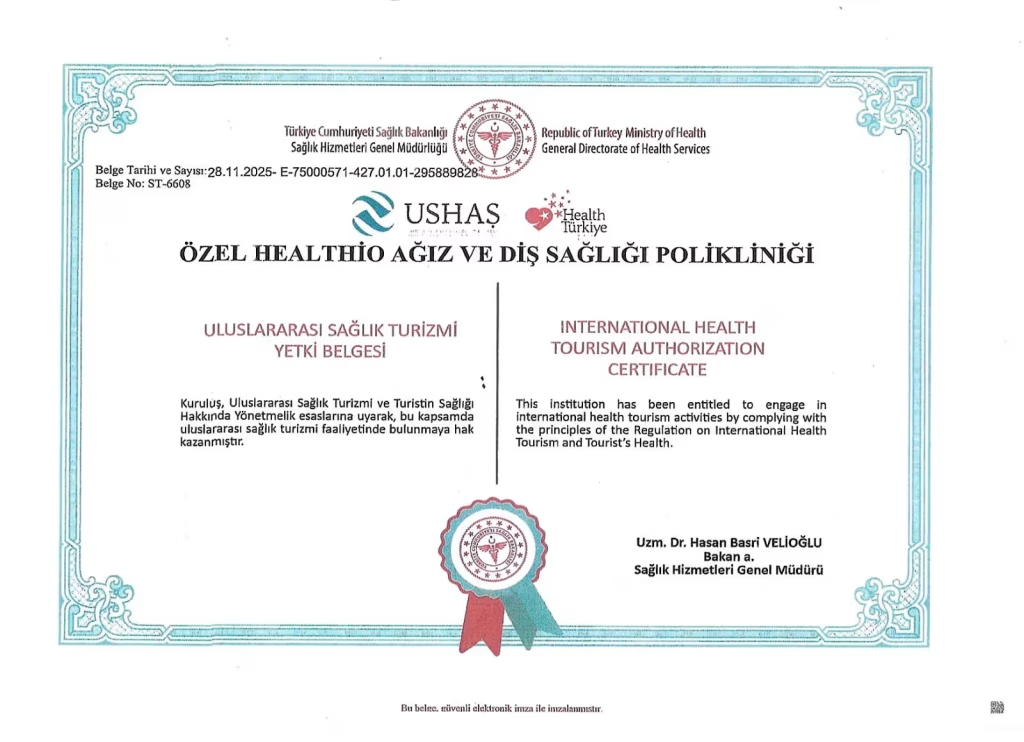
| The clinic’s health tourism authorisation | Turkey’s Ministry of Health issues an International Health Tourism Authorisation Certificate to facilities and intermediary companies that serve international patients, and publishes the lists on the website of its Health Tourism Department. Ask for the certificate and look the clinic up. |
| Who is treating you | Ask for the dentist’s full name, dental degree, postgraduate training and registration, and check them. |
| Clinic or intermediary | Ask whether you are dealing with the clinic itself or an agency that refers patients, and who is responsible for your care if something goes wrong. |
| The implant system | Manufacturer and system name stated in the written plan before treatment. |
| Planning | A CBCT scan before the final plan, with conditional items such as grafts priced in advance. |
| Consent and aftercare | A consent form you understand, written aftercare instructions and a named contact for problems after you fly home. |
Healthio Turkey is a dental clinic in Fener, Antalya, not an agency, and treatment is carried out by our own dentists. We have no UK office or partner practice: aftercare after you return is remote follow-up with the clinic, planned check visits in Antalya, written records you can show any UK dentist and the written warranty terms. Our dental implant treatment page describes how care is organised at the clinic.
Risks to understand
- Pain, swelling and bruising for a few days after surgery.
- Infection around the implant, early or years later (peri-implantitis), which is why cleaning and check-ups matter.
- An implant that does not integrate and has to be removed.
- Nerve injury in the lower jaw, causing numbness, or sinus problems in the upper jaw.
- Wear, chipping or loosening of crowns and screws over the years.
A 2019 systematic review by Howe and colleagues estimated ten-year survival at 96.4% per implant; a more cautious analysis allowing for patients lost to follow-up gave 93.2%. These figures describe groups of patients, not a promise for any individual.
Warning signs in any offer
- A firm price without X-rays or a scan.
- An unnamed implant system.
- Final implant teeth promised within a few days, with no explanation of healing.
- Pressure to pay quickly to keep a price or a date.
What Records and Implant Passport Should You Receive?
You should receive an implant passport for every implant, plus your X-rays, scan and written treatment record, so that any UK dentist can identify exactly what was placed and order matching parts. Ask for them as digital files as well as on paper.
An implant passport normally contains the following. The entries are an example of the format, not a real patient record:
| Field | Example entry | Why a UK dentist needs it |
|---|---|---|
| Tooth position | FDI 36 (lower left first molar) | Matches the record to your mouth |
| Manufacturer and system | MegaGen, AnyRidge | Identifies the connection and the tools |
| Diameter and length | e.g. 4.5 mm x 10 mm | Needed for parts and for interpreting X-rays |
| Batch (lot) number | As printed on the implant packaging label | Traceability if the manufacturer issues a notice |
| Abutment and screw | Type, height and screw used | Needed to remove, tighten or replace the crown |
| Crown and fixing | Zirconia, screw-retained or cemented | Decides how the crown can be taken off |
| Dates and grafts | Placement and loading dates; any graft material | Explains healing and future X-rays |
Also keep the written treatment plan with tooth numbers, your invoice, aftercare instructions and the written warranty terms. Our page on what the implant warranty covers explains how cover works and which check-ups it depends on.
On the NHS side, an NHS dentist is not obliged to repair or replace private treatment done abroad at no cost. Urgent care is available on the NHS at the normal charge, which in England is £27.90 for an urgent appointment; Scotland, Wales and Northern Ireland set their own charges.
Frequently asked questions
How long do I need to stay in Turkey for dental implants?
For standard treatment, plan two stays of about five to seven days each, three to six months apart. The first covers the examination, scan and surgery; the second covers the final crowns. Grafting, extractions or several implants can change this, and your written plan states the expected number of days for each trip.
Can I have implants if I smoke or have diabetes?
Often yes, with planning. Smoking roughly doubled the failure rate in one large review, so we ask you to stop or cut down for several weeks around surgery. Well-controlled diabetes is generally compatible with implants; we ask for a recent HbA1c result, and poorly controlled diabetes usually means waiting.
Do dental implants hurt?
The surgery is done under local anaesthetic, so you should feel pressure and vibration rather than sharp pain. Afterwards, soreness, swelling and sometimes bruising are common for a few days and are usually managed with simple painkillers, cold compresses and rest. Pain that increases after the third day should be reported.
Can a UK dentist service implants placed in Turkey?
Yes. Any dentist can examine implants, take X-rays and treat inflamed gums. Repairing or replacing a crown depends on the system and parts, which is where the implant passport helps. Ask your dentist in advance whether they will see you; NHS practices are not obliged to repair private work done abroad at no cost.
What is the difference between premium and value implant brands?
Premium systems usually have longer research histories, wider international distribution and higher prices; value systems cost less. For you, the practical questions are whether the system is well documented, whether parts are sold in the UK and whether you receive the exact details in writing. Both systems we use have UK distribution.
What happens if an implant does not integrate?
An implant that does not bond to the bone becomes loose and is removed. The site usually heals for some weeks or months, sometimes with a graft, before a new implant is placed. How this is handled, and who pays for the replacement and travel, should be set out in your written warranty terms before treatment.
Summary
Dental implants in Turkey follow the same biology as anywhere else: a titanium post, months of healing and a crown fitted on a second trip. What makes the difference for UK patients is a careful assessment of your health and bone, a named implant system with UK-available parts, and full records to take home.
If you are considering treatment, send your X-rays or photos for an assessment and a written treatment plan. Whether implants are right for you is decided only after an examination and a CBCT scan.
Plan your treatment with Healthio Turkey
Send us your X-rays or a few photos of your teeth. Our dentists in Antalya review them and send you a written treatment plan with the price. Whether a treatment suits you is confirmed at your examination.
Sources
- Journal of Dentistry (Howe MS, Keys W, Richards D). Long-term (10-year) dental implant survival: A systematic review and sensitivity meta-analysis. 2019. pubmed.ncbi.nlm.nih.gov
- Journal of Dentistry (Chrcanovic BR, Albrektsson T, Wennerberg A). Smoking and dental implants: A systematic review and meta-analysis. 2015. pubmed.ncbi.nlm.nih.gov
- Clinical Oral Implants Research (Schimmel M et al.). Effect of advanced age and/or systemic medical conditions on dental implant survival: A systematic review and meta-analysis. 2018. pubmed.ncbi.nlm.nih.gov
- Clinical Oral Implants Research, ITI Consensus (Gallucci GO et al.). Implant placement and loading protocols in partially edentulous patients: A systematic review. 2018. pubmed.ncbi.nlm.nih.gov
- Republic of Türkiye Ministry of Health, Health Tourism Department. Health facilities and intermediary organisations authorised by the Ministry (lists updated 20 August 2026). 2026. shgmturizmdb.saglik.gov.tr
- NHS. How much NHS dental treatment costs. 2025. nhs.uk